Not on a Tuesday afternoon, and certainly not at two in the morning when an emergency case rolls through the door.
That leaves the vet on shift reading their own films while also running the floor. It works until it does not, and the findings that get missed tend to be the subtle ones that matter most.
Remote radiology closed that gap. The question now is not whether to use it, but which provider suits the way a given practice actually works.
Key Takeaways
- Turnaround tiers matter more than headline speed. Look for a stated time for radiographs and a separate one for CT, MRI and ultrasound.
- Check who actually reads the study. Some providers use board-certified specialists only, others pair artificial intelligence with specialist review.
- Contracts and case minimums vary widely. Several providers now offer pay-per-case with no commitment.
- Modality coverage and species coverage are separate questions. Exotics, birds and reptiles are not universally supported.
- Ask whether you can speak to the reading radiologist afterwards, because a report you cannot query is worth less.
![]()
Read also:
What Remote Radiology Actually Involves
The mechanics are simpler than most practices expect. Images are sent from the clinic’s imaging system to the provider, usually through a DICOM destination or a direct upload, and a radiologist reads them remotely.
A written report comes back within an agreed window. Most providers offer a rush option for cases where the read changes what happens next, and a slower routine option for everything else.
No special hardware is typically needed. An internet connection and the ability to route images out of the practice system is usually the whole requirement.
How to Judge a Provider
Five things separate a good fit from an expensive mismatch.
First, turnaround by service level, stated in hours rather than adjectives. Second, who performs the read and whether they are board-certified. Third, modality and species coverage against your actual caseload.
Fourth, commercial terms, meaning contracts, minimums, setup fees and whether weekends and holidays cost extra. Fifth, access to the radiologist for follow-up questions.
Eight Providers Worth Shortlisting
1. RadsForVets
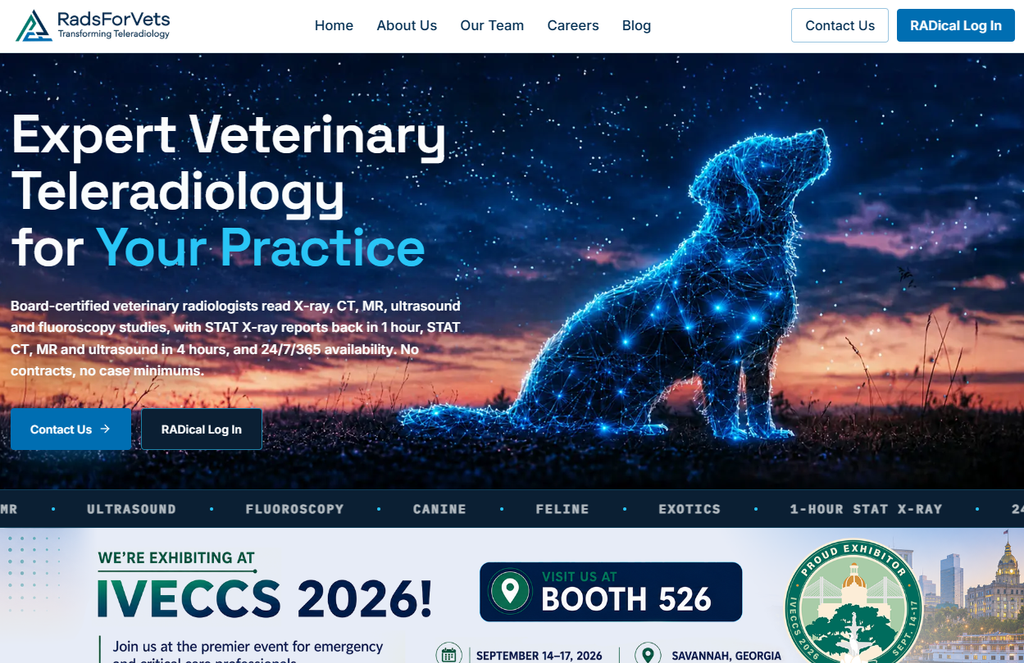
Every case is read by a board-certified veterinary radiologist rather than an automated system, across X-ray, CT, MR, ultrasound and fluoroscopy, for dogs, cats and exotics.
Turnaround comes in three tiers. A Wet Read is the fastest option and is read while you wait, STAT radiographs are completed within one hour and STAT CT, MR and ultrasound within four, with standard cases back inside 24 hours.
RadsForVets offers Veterinary Teleradiology with no contracts and no monthly case minimums, so the pricing and service level hold whether a clinic sends one case a month or fifty. Cases are submitted through its RADical platform by DICOM auto-send or direct upload, live support is staffed around the clock, and clinicians get direct access to the reading radiologist for follow-up questions.
Best for: practices that want tiered urgency options and no commitment.
2. VetRad
Veterinarian owned and led, VetRad runs a nationwide network of board-certified veterinary radiologists supporting more than 1,000 referral partners across the United States.
STAT digital radiograph interpretations are available around the clock, with a published average return of 15 minutes or less against a guaranteed one-hour turnaround.
STAT CT and MRI carry a guaranteed four-hour turnaround when submitted Monday to Friday between 8:00 am and 4:00 pm Eastern, which is worth checking against your own overnight volume.
Best for: practices that want a guaranteed radiograph turnaround from an established network.
3. VET.CT
VetCT radiologists read x-ray, CT, MRI, nuclear medicine and fluoroscopy, which makes it a strong option for hospitals with cross-sectional imaging on site.
The service runs on a pay-per-case basis with no minimum monthly submission, and cases are sent by adding a DICOM destination or uploading directly through the website.
Case status and final reports are viewed and downloaded from the same platform used for submission, so tracking does not require a separate system.
Best for: referral centres with CT or MRI and international coverage needs.
4. Vet’s Choice Radiology
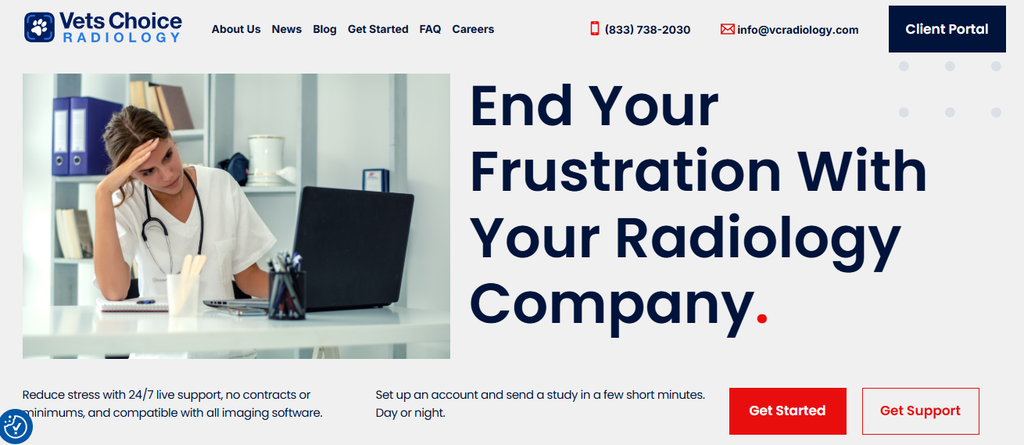
A full-service provider operating 24/7/365, with a team the company describes as more than a hundred board-certified radiologists covering X-ray, CT, MRI and ultrasound.
Its distinguishing commercial promise is a guaranteed or free model, meaning the clinic does not pay if the report arrives late. There is no contract and no minimum requirement.
Radiologists interpret ultrasound studies they did not personally acquire, and images and reports are archived for five years, which helps when a case resurfaces.
Best for: clinics that want a turnaround guarantee backed by a refund.
5. IDEXX Telemedicine Consultants
IDEXX gives practices direct access to a dedicated team of board-certified radiologists available 24/7/365, sitting inside its wider diagnostic imaging portfolio.
Published turnaround is a detailed written interpretation within one hour for STAT cases and 24 hours for routine studies, with a note directing users to check current availability in their account.
Coverage extends beyond radiographs to CT and MRI interpretation alongside patient history, plus ultrasound reports with clear conclusions, and the consultant network also spans cardiology and other specialties.
Best for: practices already running IDEXX imaging equipment and software.
6. Antech Imaging Services
Part of the Mars Veterinary Health group, Antech pairs board-certified radiologists with AI-assisted interpretation tools and bundles imaging equipment alongside the reading service.
Its RapidRead tool was developed by board-certified radiologists and Mars Petcare data scientists, covering more than 50 of the most common findings in the thorax, abdomen and limbs for dogs and cats.
Findings are combined with the attending veterinarian’s own observations, and board-certified radiologists perform quality checks on the AI output.
Best for: larger groups wanting equipment, AI screening and specialist reads from one supplier.
7. Vetology
Vetology combines AI radiology reports, teleradiology by board-certified radiologists and an AI-assisted preliminary report writing platform in a single system.
Preliminary AI screening results arrive in minutes, which lets a clinician start reasoning about a case while the full specialist report is prepared.
Species coverage is unusually broad, spanning dogs, cats, small mammals such as rabbits and ferrets, birds including poultry, reptiles and equine patients, and the platform integrates with existing clinic systems.
Best for: clinics wanting fast AI screening ahead of a specialist read.
8. Golden Hour
Founded by the original team behind PetRays, Golden Hour positions itself squarely against automated reads and offshore interpretation.
Every study is read by a US-licensed, ACVR board-certified veterinary radiologist, with no AI involvement, no overseas readers and no residents performing the interpretation.
Commercially it runs on no contracts, no minimums and no setup fees, and the company states there are no weekend or holiday surcharges, which matters for emergency hospitals.
Best for: emergency practices that want human-only reads and flat pricing.
Why the Report Speed Matters to Pet Owners Too
Plenty of the cases that end up on a radiologist’s screen start with something the owner never saw coming. A swallowed toy, a mouthful of raw dough, a plant nibbled off a windowsill.
Those presentations often look vague at first, which is exactly when imaging earns its keep. It is worth knowing the hidden illness triggers that send pets to the clinic in the first place, because the sooner the history is clear, the more useful the radiographs become.
For the practice, a one-hour read means the treatment plan changes while the patient is still on the table. For the owner, it means fewer overnight stays waiting for an answer.
Questions to Ask Before You Commit
Get the turnaround times in writing, separated by modality and by hour of day. A one-hour radiograph promise that only applies during business hours is a different product from one that applies at 3 a.m.
Ask whether the read is performed by a board-certified radiologist, and whether AI is used for screening, for drafting or not at all. None of those are wrong, but you should know which you are buying.
Then confirm the commercial basics. Contract length, case minimums, setup fees, weekend and holiday surcharges, and how long images and reports stay accessible.
The Bottom Line
There is no single best provider here, only a best fit. A busy emergency hospital needs guaranteed overnight speed, a general practice sending a handful of cases a month needs flexibility and no minimums, and a referral centre with CT needs genuine cross-sectional depth.
Match the service tier to the cases that actually keep you up at night, check the commercial terms before the first submission, and make sure you can pick up the phone and speak to the person who wrote the report.
Frequently Asked Questions
What is veterinary teleradiology?
It is the remote interpretation of animal imaging studies by a specialist radiologist. The clinic sends images electronically and receives a written diagnostic report, usually within a turnaround window chosen per case.
How fast can a clinic get a radiology report back?
It depends on the tier selected. Several providers publish one-hour turnaround for urgent radiographs and around four hours for urgent CT, MRI and ultrasound, with routine studies typically returned within 24 hours.
Are these reports written by artificial intelligence?
It varies by provider and is worth asking directly. Some use board-certified radiologists exclusively, others offer AI screening in minutes followed by a specialist report, and some combine both with radiologist quality checks.
Do practices have to sign a contract?
Not usually. Several providers now operate pay-per-case with no contract, no monthly minimum and no setup fee, though terms differ and should be confirmed before the first case is sent.
Can exotic pets and birds be covered?
Some providers read exotics, birds, reptiles and equine patients, while others focus on dogs and cats. Check species coverage against your caseload rather than assuming it is universal.
Our team may have used AI to assist in the creation of this content, which has been reviewed by our editors.
![]()
Read also: